Sub-Total: $0.00

An Overview of Our EMDR Training Program
This Course in Accredited by the EMDR International Association
Learning EMDR is something that takes time. It is not that the concepts are difficult, it is just that there is considerable material to become familiar with in the process, and it is a process. We have designed the course to help you master it a little at a time. EMDR has numerous protocols and procedures. This is where the challenge lies. The only way one becomes adept at this mode of therapy is to do it and practice it. This will result acquiring the necessary skills. While becoming familiar with the protocols is relevant to mastering EMDR , one also must be able to use their clinical judgment in making decisions in EMDR sessions. Therefore, having more years of clinical experience may make the ability to master EMDR easier. However, we have taught clinicians from all levels of experience, and we have helped them to use EMDR.
The course is taught in 2 parts. Part 1 is designed to help the participant master the basics of EMDR therapy. It is important that we provide you with a foundation to learn and become adept with this treatment modality. The manual is written in such a way that all the procedures and protocols are discussed in considerable detail. This makes it very easy to use the manual as an easy reference for incorporating this into one's practice. We do not teach this in a manner that is robotic. It is important that we teach you as clinicians and therefore, one is able to think and make good clinical decisions while mastering EMDR. Initially, it may feel mechanical as you become more familiar with EMDR. In time though, it will become more fluid.
Part 2 teaches more advanced techniques such as working with select populations, the cognitive interweave, and discussions on how to treat more complex cases such as complex PTSD, personality disorders, and dissociation. It should be stated that if one does not have experience in treating such disorders they would need additional training beyond this course. It is outside the scope of this course to be able to teach everything that would be needed to treat such difficult types of presentations. EMDR is not a stand-alone therapy. What this means is that just because one has studied EMDR, it does not mean they can treat disorders they have not been trained to treat outside of EMDR.
Students may be concerned about remembering all that is taught in the 3-day courses. The manual that you will receive as part of the course has been written in such a way that it will guide you step-by-step through each phase of the EMDR Training Course.
As previously stated this course is taught in two parts. Part 1 teaches the basics so that the potential clinician can master a foundation of EMDR and its approach. Part 2 teaches more advanced techniques for working with more difficult situations. The new clinician to EMDR we'll be able to use it after Part 1. However, this will be with less complicated types of cases. For example, depression, anxiety, simple PTSD and other less complicated types of disorders would lend itself well to the Part 1 clinician.
The format for both courses includes a morning lecture covering didactic material. This material is related to the concepts, theoretical constructs, and protocols associated with EMDR. The afternoon is a hands-on practicum where the attendees learn to use EMDR by practicing with each other.
All students are required to obtain the textbook "Eye Movement Desensitization and Reprocessing: Basic Principles, Protocols, and Procedures," by Francine Shapiro, Ph.D. part 1, chapters 1–8 should have been read before the training. For Part 2, chapters 9–11 should have been read. The course manual will be available electronically upon completion of registration and payment.
Basic Training Hours
This course is taught in 2 parts. Students will complete 50 hours of education while learning EMDR.
Part 1 consists of 10 hours of lecture, 10 hours of supervised practice exercises, and 5 hours of consultation. Part 2 consists of the same number of hours for a total of 50 hours.
EMDR Training Part 1
Part 1 Course Objectives
- The student will be able to use EMDR as a form of psychotherapy for simple cases of trauma. This means cases of simple PTSD, mood, or anxiety disorders. The first part of this course does not cover working with complex cases of trauma, such as clients with extensive histories of abuse or dissociative disorders.
- The student will be able to describe and understand the adaptive information processing model (AIP) and its relevance to EMDR.
- The student will be able to know and understand what the components of a memory are as they relate to EMDR.
- The student will know and be able to describe the 8 phases of EMDR therapy.
- The student will be able to know and understand the basics of current EMDR research and its clinical relevance.
- The student will be able to know and utilize the criteria for the selection of an EMDR client.
- The student will know how to gather a history and develop an EMDR treatment plan for noncomplex cases. (See objective 1 on the limitations or Part 1 training).
- The student will know how to use EMDR in a responsible manner. Meaning he/she will be able to properly prepare a client for EMDR therapy and conduct a session properly while maintaining client safety at all times.
- The student will be able to explain EMDR to clients and prepare them for treatment.
- The student will have confidence that he/she can use EMDR in their practice.
- The student will have gained new skills and can use them in their practice immediately.
Part 1 Outline
The goal of the first part is to familiarize the client with the basics of the EMDR procedural steps and protocol. Through this instruction, the student will obtain the necessary knowledge and skills to begin the use of EMDR in his/her practice.
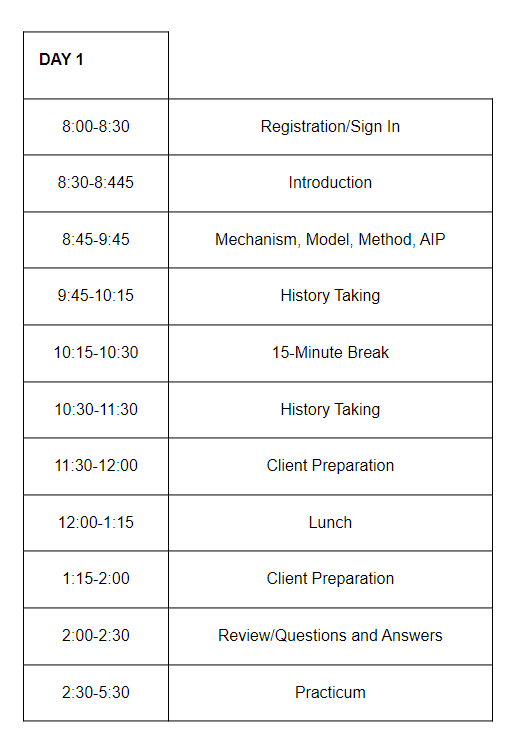
Day 1
- Introduction to the Origins and Development of EMDR.
- Instruction on the Adaptive Information Processing (AIP) Model
- Instruction on Phase 1: History of EMDR & Phase 2: Client Preparation
- Practice exercises in developing skills for history taking and client preparation.
- Approximately 4 hours ’ lecture and 3 hours ’ practice training exercises.
Day 2
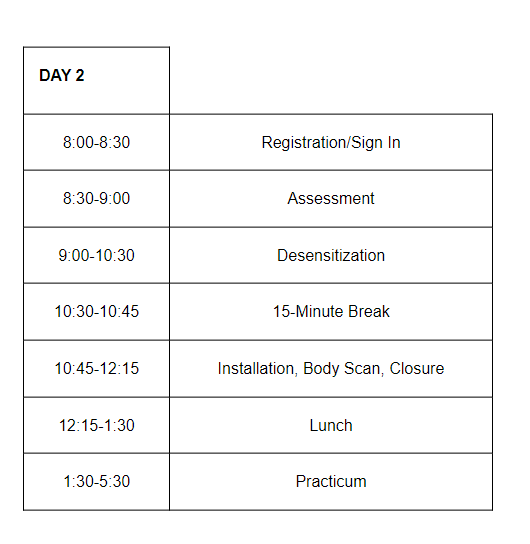
- Complete instruction on Phases 3-7: Assessment, Desensitization, Installation, Body Scan, & Closure.
- Practice exercises with Processing a Memory with Phases 3–7. Approximately 3.5 hours.
Day 3
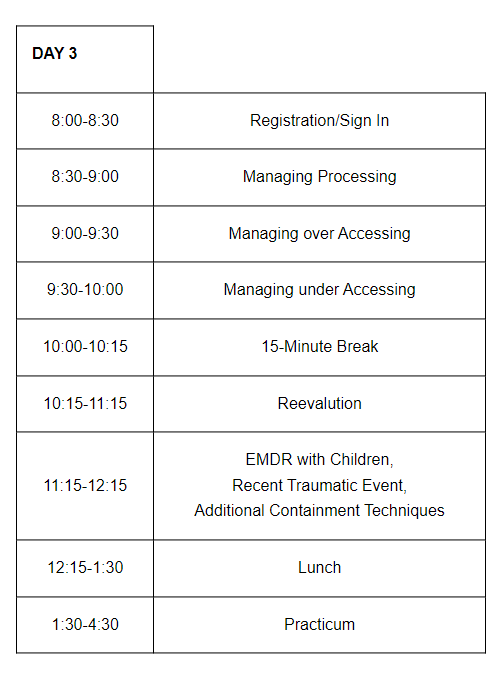
- Instruction on managing processing, processing current triggers, and future concerns; the protocol for the future template; EMDR with children; the protocol for recent traumatic events; and additional containment skills. Approximately 3.5 hours.
- Practice exercises re-evaluating processed memory, processing additional relevant memories, current triggers, and future templates. Approximately 3.5 hours.
EMDR Training Part 2
Part 2 Course Objectives
- The student will be able to use EMDR as a form of psychotherapy for more complex cases of trauma. This means cases of complex PTSD, mood, or anxiety disorders. The first part of this course does not cover working with complex cases of trauma, such as clients with extensive histories of abuse or dissociative disorders.
Note: completion of Part 2 of this course does not qualify a student to treat dissociative disorders if they have not had experience and training in treating them before taking this course. There is a difference between a dissociative symptom, which is part of the traumatic experience, and a dissociative disorder. - The student will have a complete understanding of the adaptive information processing model (AIP) and its relevance to EMDR.
- The student will have a complete understanding of the 8 phases of EMDR therapy.
- The student will have a complete understanding of the criteria for the selection of an EMDR client. They will know which client is a good candidate for EMDR and which clients may be at risk during trauma therapy and may need more preparation.
- The student will have a thorough understanding of how to gather a history and develop an EMDR treatment plan for complex cases.
- The student will know the difference between treating PTSD and treating trauma.
- The student will be able to use EMDR in a responsible manner by utilizing the procedures of EMDR as taught and maintaining client safety at all times.
- The student will be able to explain EMDR to clients and prepare them for treatment.
- The student will have confidence that they can use EMDR in their practice with the disorders in which they have the experience to treat.
- The student will have a thorough understanding of the cognitive interweave and can incorporate this into their EMDR sessions.

Part 2 Outline
The goal of the second part is to review the basic EMDR protocols and procedures taught in Part 1. In addition, the second part will develop methods of treating more complex cases. This includes the development of treatment plans for complex cases, dynamics of trauma, and use of the cognitive interweave.
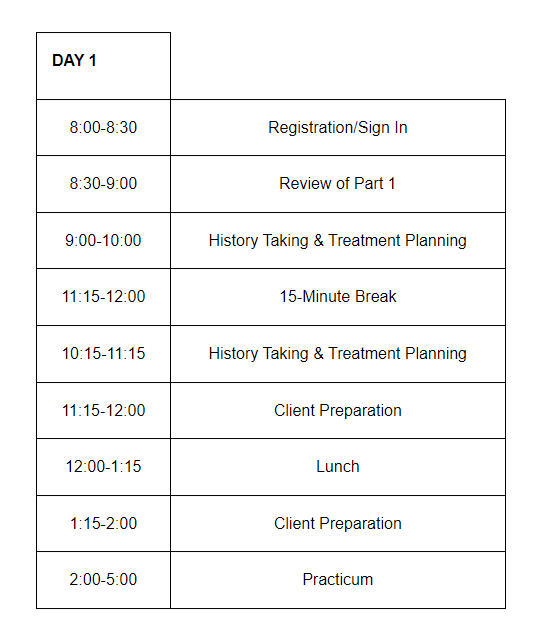
Day 1
- Review of the 8 EMDR phases, AIP, and the 3 stages of treatment: past, present, and future.
- History taking, phase 1, with complex cases as well as client preparation.
- Resource Development and Installation (RDI). Lecture approximately 4 hours.
- Practice exercises taking history, client preparation, and RDI. Approximately 3 hours.
- Approximately 4 hours ’ lecture and 3 hours ’ practice training exercises.
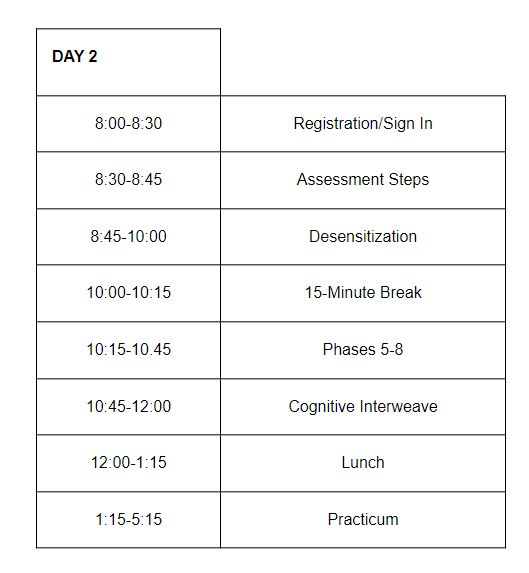
Day 2
- Use of phases 3–8 with more complex presentations and managing abreactions as well as over- and under-accessing during desensitization.
- Instructions on the cognitive interweave. Lecture approximately 3.5 hours.
- Practice exercises with processing a memory using phases 3–7. Exercises approximately 4 hours.
Day 3
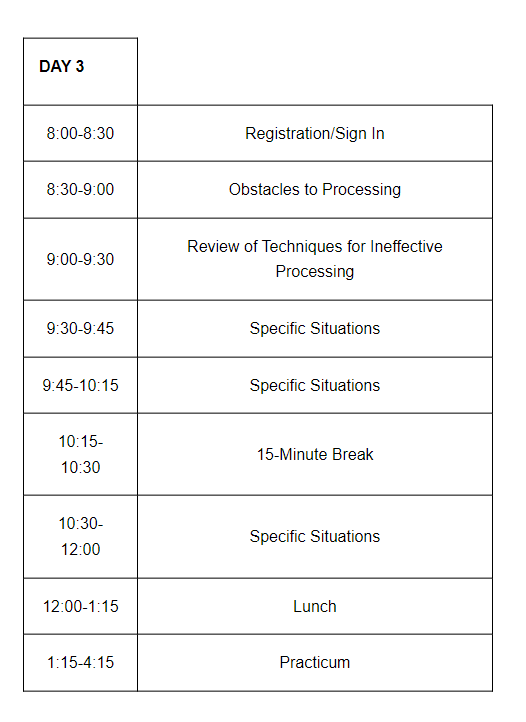
- Instruction on obstacles related to processing, dissociation, treating specific situations such as phobias, illness and somatic disorders, self-use of eye movements, grief, adults abused as children and sexual abuse, couples, and combat and first responders. Approximately 3.5 hours.
- Practice exercises for completing the EMDR treatment plan: past, present, and future. Approximately 3.5 hours.
Consultation Requirements
You must complete 5 hours of consultation after part 1 and 5 hours of consultation after part 2. You may do your consultation with me or with a facilitator who assisted in teaching the course. Not every course may have a facilitator if there were only 10 students in the class. You may also consult with any approved consultant, which you can find on EMDRIA’s website.
- The cost for an individual consultation is $100 per hour. This can be done face-to-face or via the phone.
- The cost for group consultation is $50 per session. In group consultations, each participant must be allotted 15 minutes to present and discuss his/her cases. However, this still counts as one hour of consultation.
- Consultation is important, as this will help you integrate EMDR into your practice as well as master this therapeutic approach.
If you have any questions or inquiries, call us at (318) 834-0969 to get more information.